

You know the call needs to be made. The message needs an answer. The bill needs attention. You have thought about doing it all morning, perhaps all week. Yet each time you reach for your phone, your mind fills with questions. What if you say the wrong thing? What if the person is upset? What if this one decision creates a problem you cannot fix?
So you put it off. For a moment, you feel relief. Then the task is still there, and now you are upset with yourself for avoiding it. Tomorrow, it may feel even harder.
This is what people often mean when they say anxiety is paralyzing. They are aware of what needs to happen. They may care deeply about it. The difficulty is moving from thinking to doing while their mind and body are responding as though the task is dangerous.
If this sounds familiar, calling yourself lazy will not help you understand the pattern. Learning to recognize it can help you find a way through it.
What paralyzing anxiety can look like
Anxiety does not always look like pacing, crying, or a panic attack. Sometimes it looks like sitting still for hours while your mind races. It can look like rewriting an email ten times, asking several people the same question, or researching every possible outcome without choosing one. It can look like a person who is highly capable at work but cannot open a letter at home.
You might notice yourself:
• Avoiding a phone call because you are afraid of how the other person will respond.
• Delaying a decision until you feel completely certain, even though certainty may never come.
• Reading the same information repeatedly without being able to act on it.
• Seeking reassurance, feeling better briefly, and then needing reassurance again.
• Feeling tense, nauseated, restless, exhausted, or unable to concentrate when a task comes up.
• Letting several small tasks pile up until the pile itself feels overwhelming.
None of these behaviors, by itself, tells us that someone has a particular anxiety disorder. They do tell us that the person's distress deserves attention, especially when everyday responsibilities and relationships are being affected. Anxiety can interfere with concentration, sleep, work, and ordinary activities. The National Institute of Mental Health describes these effects in its guidance on anxiety.
Why doing nothing can feel safer
When you expect a task to bring embarrassment, conflict, rejection, or a mistake, your attention may shift away from the task itself and toward every possible consequence. A simple message becomes a rehearsal for an argument that has not happened. A routine appointment becomes a series of frightening “what if” questions.
Avoidance offers quick relief. You close the email, postpone the call, or ask someone else to decide. Your discomfort drops for a little while. That relief can make avoidance more tempting the next time. Meanwhile, the unanswered message or unfinished task may grow more urgent. You may begin to fear the task and the consequences of having delayed it.
This is one reason shame makes the cycle worse. “Why can't I just do this?” adds another painful thought to a situation that already feels hard. A more useful question is, “Which part of this task is setting off my anxiety?” The answer may be uncertainty, fear of disapproval, a past experience, the number of steps involved, or the belief that you must handle it perfectly.
Finding the pressure point helps you choose a response that fits the problem.
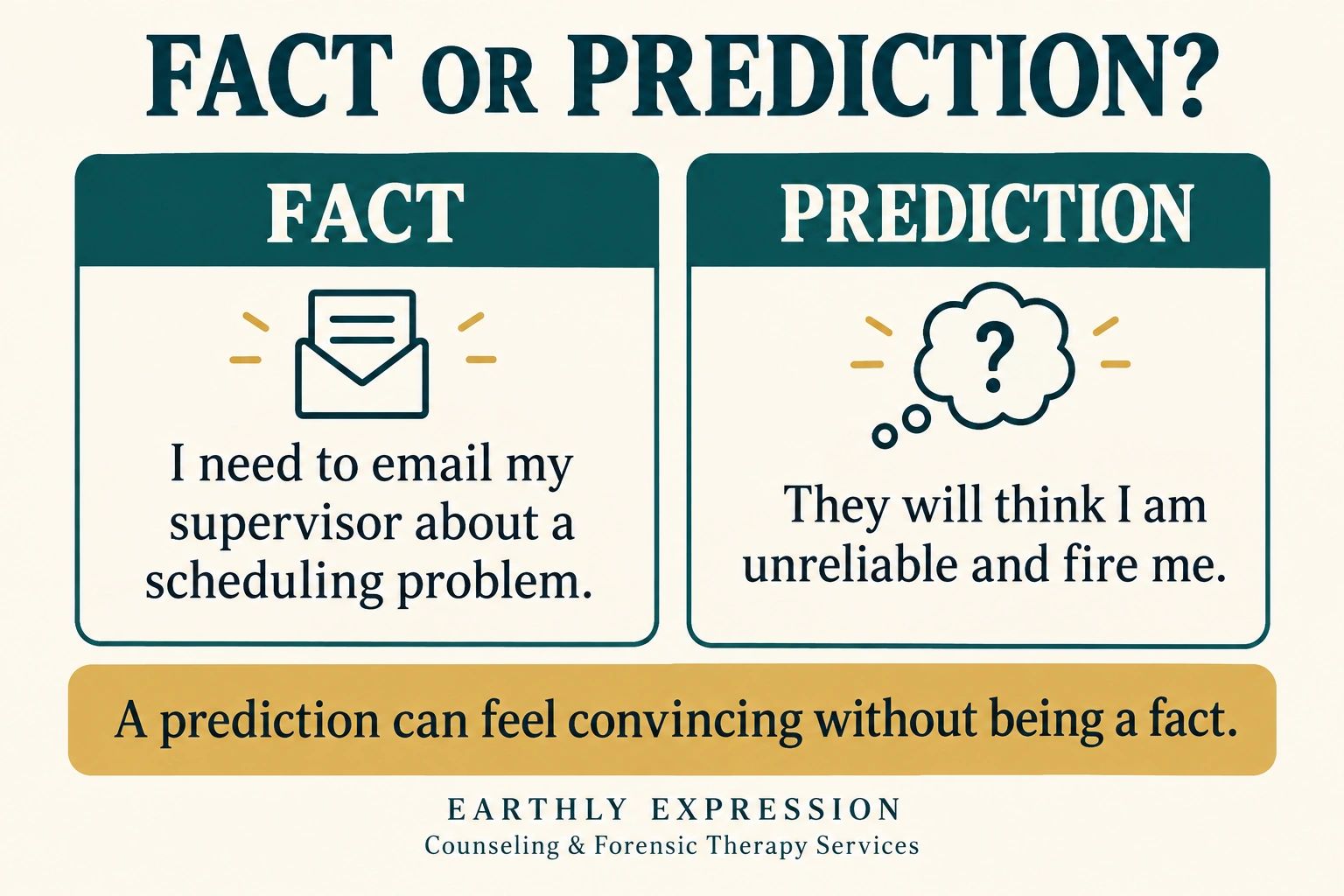
Start by separating facts from predictions
An anxious thought can sound so convincing that it begins to feel like a fact. Before acting, try writing down what you actually know and what your mind is predicting.
For example:
Fact: “I need to email my supervisor about a scheduling problem.”
Prediction: “They will think I am unreliable and fire me.”
The prediction may feel frightening, but it is still a prediction. You do not have to convince yourself that everything will go well. Ask whether other outcomes are possible and what you would do if the difficult outcome occurred. This moves you from trying to guarantee the future to preparing for it.
You can also ask, “What decision is required today?” Sometimes your mind is asking you to solve next month, next year, and every person's reaction before you send one email. Bring your attention back to the actual decision in front of you.
Make the first step smaller than the whole task
“Take care of my finances” is too large to be a first step. “Open the envelope” is a first step. “Fix my relationship” is too large. “Ask for a time to talk” is a first step. When you are frozen, your goal is to create movement, not to finish the entire problem in one sitting.
Try a short sequence:
• Name the task. Write one sentence about what needs to happen.
• Choose a step you can do in five minutes. Open the message, find the phone number, or write the first line.
• Decide when you will do it. “After lunch” is clearer than “later.”
• Stop and notice what happened. Did the anxiety rise, fall, or stay the same? What did you learn?
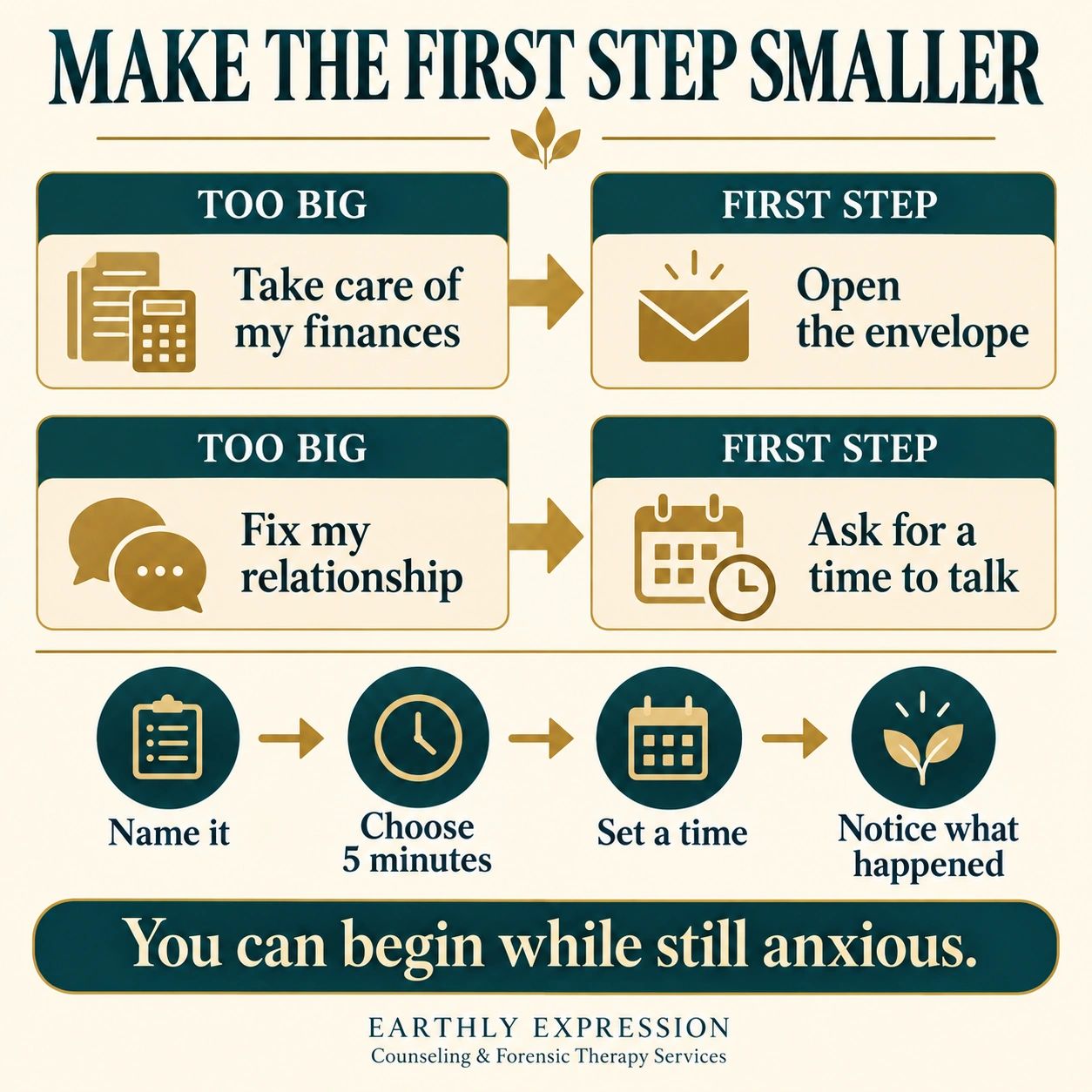
You may still be anxious when you take the step. Progress does not require a calm feeling first. Sometimes a manageable action gives your mind new information: “I can do this part, even with discomfort.”
If the first step still feels impossible, make it smaller. Put the envelope on the table. Save the contact in your phone. Write a rough sentence that you do not send. Small is not the same as meaningless. It is a way to begin.
Give your body a chance to settle
Anxiety is experienced in the body as well as in your thoughts. Tight muscles, a racing heart, an unsettled stomach, and shallow breathing can make an ordinary task seem even more threatening. Notice what is happening physically before you try to reason your way through every possible outcome.
Place your feet on the floor. Look around and name a few things you can see. Relax your shoulders if they are raised. Take a few comfortable, slower breaths without forcing them. You might take a brief walk, drink water, or step away from a crowded screen.
These actions are not a test of whether you can make anxiety disappear. They are ways to give yourself a little more room to choose what happens next. If a breathing exercise makes you more uncomfortable, use a different way to ground yourself. The goal is a workable next step, not a perfect technique.
Then return to the question: “What is the smallest action I can take now?”
Watch for the perfection trap
Some people freeze because they believe there is one correct choice and a mistake would be unbearable. They spend hours searching for the perfect words, the perfect timing, or enough information to remove all risk. More preparation can be helpful up to a point. After that, it may become another way to avoid acting.
Ask yourself whether the task truly requires a perfect answer. Most emails can be clarified. Many decisions can be adjusted. A conversation can begin with, “I need a moment to think about that.” Even important choices are often made with incomplete information.
Consider setting a reasonable limit. You might give yourself fifteen minutes to draft a routine message and one review before sending it. For a larger decision, identify the information you actually need and a date to decide. The limit is not meant to rush you into a harmful choice. It helps you recognize when more thinking is no longer helping.
You can care about doing something well without requiring yourself to do it flawlessly.
Notice when reassurance stops helping
Support from other people can be valuable. A friend may help you think through a difficult conversation or remind you that you have handled something similar before. But if you ask the same question repeatedly and relief lasts only a few minutes, reassurance may have become part of the anxiety cycle.
Before seeking another opinion, ask: “What information am I missing?” If the answer is “none,” you may be hoping someone can promise that nothing uncomfortable will happen. No one can give you that promise.
Try deciding what kind of support you actually need. You might say, “Please sit with me while I make this call,” or “Can you help me choose my first step?” That is different from asking someone to make every decision or guarantee the outcome. Good support helps you act with more confidence over time.
If the issue requires specialized advice, such as a medical or legal decision, seek appropriate expertise. For an ordinary choice, practice tolerating some uncertainty while you move forward.
Put language to what is happening
People around you may only see the missed deadline, unanswered message, or canceled plan. They may not see the hours of worry behind it. You do not owe everyone a full explanation, but a short, honest statement can reduce confusion and help you ask for what you need.
You might say:
• “I have been anxious about this conversation, and I need a little time to organize my thoughts.”
• “I am having trouble starting. Could you help me identify the first step?”
• “I cannot answer tonight, but I will respond by tomorrow afternoon.”
Notice the difference between explaining your difficulty and disappearing from the situation. Anxiety may help explain why responding is hard. It does not mean other people can always wait without information. A brief update and a realistic time frame can protect both your relationships and your sense of accountability.
If you miss the time you gave, follow up. You can acknowledge the delay without writing a long defense of yourself.
Build a plan for recurring situations
Paralyzing anxiety often returns in familiar places: money, conflict, health concerns, work evaluations, dating, or decisions that affect your family. Once you spot a pattern, prepare for it before the next difficult moment.
Write down three things: the situations that tend to stop you, the thoughts you usually have, and one action that has helped you begin. Keep the plan practical. If phone calls are hard, prepare a short script and the number in advance. If bills trigger avoidance, choose one time each week to review them and have a trusted person available for support. If conflict makes you freeze, write the main point you want to communicate before the conversation.
Your plan should also include what to do when a strategy is not working. Perhaps you need to take a short break and return at a set time. Perhaps the task needs to be divided further. Perhaps you need help from someone trained to address the anxiety itself.
The goal is to give yourself a route back to action instead of starting from scratch each time.
What if the first step does not go well?
Sometimes you make the call and the conversation is uncomfortable. Sometimes you send the email and receive a response you did not want. Anxiety may treat that moment as proof that you should have avoided the task. But an unpleasant outcome does not automatically mean your decision to act was wrong.
Pause and look at what actually happened. Did the outcome match your prediction, or only part of it? What could you address, clarify, or repair? What was outside your control? If you made a mistake, identify the specific mistake instead of turning it into a judgment about your character. “I forgot to attach the document” can be fixed. “I ruin everything” gives you nowhere useful to go.
You can also give yourself credit for tolerating the conversation or completing the task. That does not require pretending the experience was easy. It means recognizing that you acted while uncertain and learned something from the result.
If a step genuinely was too large, adjust the plan. Practice the conversation with a trusted person. Prepare one or two sentences. Ask for help with the part that overwhelmed you. A difficult attempt is information, not a reason to abandon the goal.
Make everyday conditions a little easier
When anxiety is already high, ordinary demands can use up the attention you need for a difficult task. Consider the basics that support you: enough sleep, regular meals, movement you can manage, and breaks from constant checking or searching. Notice whether caffeine or a lack of sleep makes your worry harder to handle. These habits do not replace treatment, but they can make it easier to use the skills you are practicing.
You might also make decisions when you are less overwhelmed. Draft an important message during a quiet part of the day. Put necessary paperwork in one place. Decide in advance whom you will contact if you get stuck. The aim is not to organize every minute of your life. It is to remove a few obstacles between you and the action that matters.
When to reach out to Earthly Expression
There is a difference between having an anxious day and repeatedly being unable to do what matters to you. If anxiety is keeping you from work, relationships, appointments, sleep, or basic responsibilities, reach out to Earthly Expression. You do not have to wait until every part of your life is affected before asking for help.
In counseling with me, we can look at the situations that stop you, the thoughts that intensify your anxiety, and the patterns of avoidance that keep you stuck. We can build practical steps that fit your life, work on how you respond to uncertainty, and make room for progress without demanding perfection. If your symptoms may also have a physical cause or you want to explore medication, I can encourage you to discuss those concerns with your medical provider. NIMH describes treatment options and when to seek help.
The small steps in this article can help you begin, but you do not have to work through persistent or severe anxiety on your own. Contact Earthly Expression to discuss counseling and take the next step with support. If you are having thoughts of hurting yourself, seek immediate help instead of waiting for an appointment. In the United States, call or text 988. Call 911 if there is an immediate threat to life. NIMH provides guidance on getting help.
You do not need to solve everything today
Anxiety often tells you that you must be completely sure before you begin. Life rarely offers that kind of certainty. What you can do is notice the pattern, check which thoughts are facts and which are predictions, and choose one step that fits the moment.
You might make the call and still feel nervous. You might send the message and need to rest afterward. You might complete only the first piece of a larger task. None of that erases the progress you made.
The question is not, “Why can't I handle everything?” Ask, “What can I do next, with the support and information I have right now?” Then let that answer be enough for the first step.
Earthly Expression provides counseling and forensic therapy services. This article is educational and does not provide an individual diagnosis or treatment plan.